The Dubai real estate market maintained its upward trajectory throughout the third quarter of 2025, defying traditional seasonal lulls to deliver a record-breaking performance. Characterized by high liquidity, record transaction volumes, and sustained price appreciation, the sector continues to establish itself as a premier global destination for investors.
Market Performance and Key Metrics
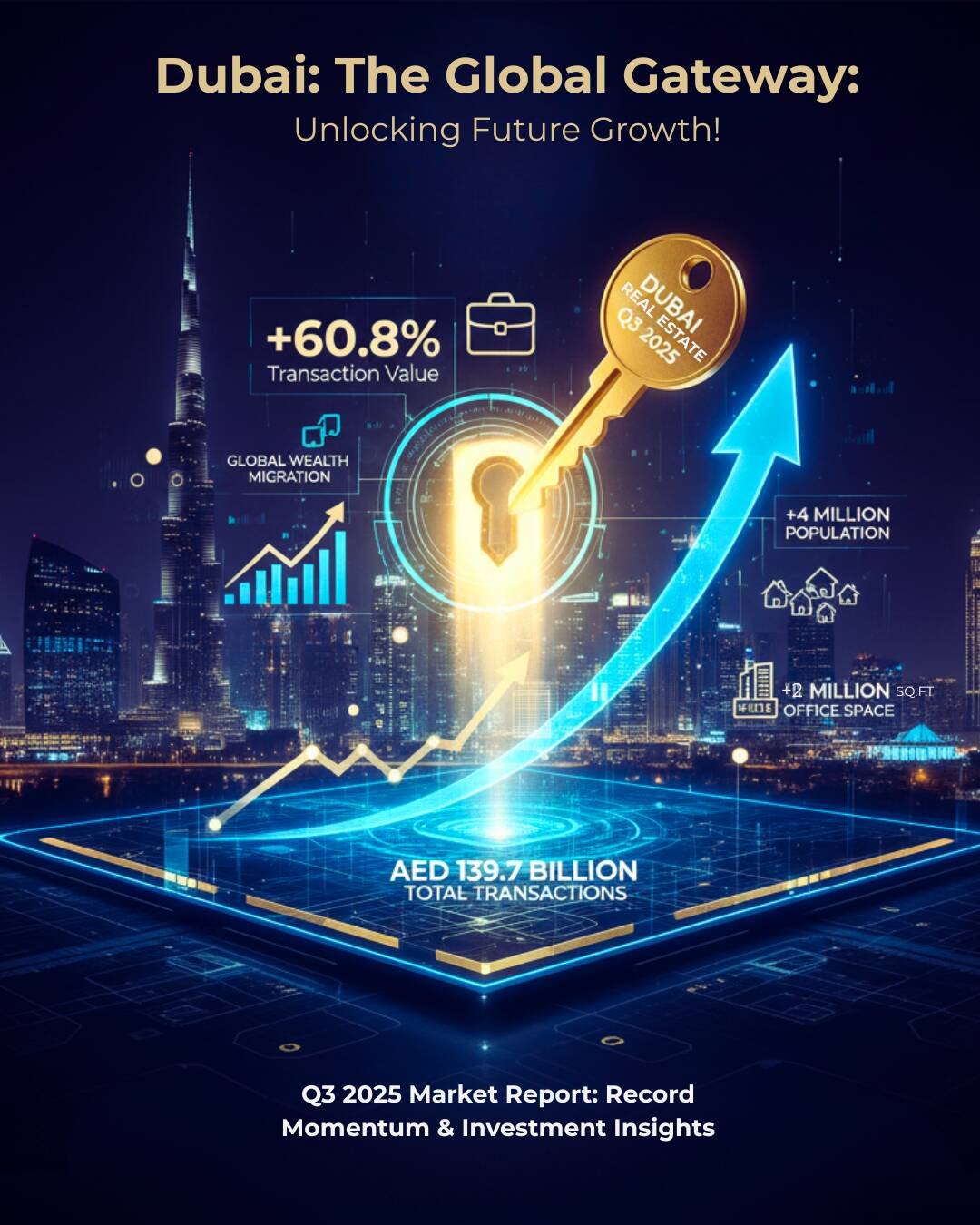
During Q3 2025, Dubai’s residential market reached unprecedented heights, recording AED 139.7 billion in total transaction value across 56,723 units. This represents a significant 11% increase in transaction volumes compared to the previous quarter. When compared to Q3 2023, the growth is even more stark, with some reports indicating a 60.8% increase in transaction value over the two-year period.
• Price Appreciation: Average prices per square foot reached approximately AED 1,814 to AED 1,913. Specifically, apartment prices grew by 3% quarter-on-quarter (13% YoY), while villa prices increased by 4% quarter-on-quarter (14% YoY).
• Rental Growth: The rental market remained firm, with both apartment and villa rents rising by 2% quarter-on-quarter. Upgraded units and prime locations continue to attract premium rates.
• Off-Plan Dominance: The off-plan sector remains a massive driver of activity, accounting for AED 103.8 billion of the total quarterly value. These transactions are supported by flexible payment structures and programs like the First-Time Home Buyer initiative.
Economic and Demographic Drivers
The “unstoppable momentum” of the market is underpinned by robust fundamental drivers:
• Population Growth: Dubai’s population has officially crossed the 4 million threshold, creating organic demand across all property segments.
• Wealth Migration: The emirate continues to attract global wealth, with an estimated 9,800 new millionaires expected to arrive in 2025 alone. Dubai now ranks as one of the world’s busiest markets for ultra-luxury transactions valued above $10 million.
• Macroeconomic Strength: The UAE’s non-oil GDP is forecast to grow by 5.0% in 2025, sustaining the overall real estate landscape.
Commercial and Industrial Outlook
Beyond residential, other sectors are showing strong performance due to supply constraints. Over 2 million square feet of new office space was announced in Q3 to meet demand from multinational expansions and regional headquarters. Similarly, the industrial sector is seeing widespread rental growth, leading to an increase in speculative development starts.
Is It the Right Time to Invest?
According to the sources, the current market dynamics present compelling prospects for discerning investors.
Reasons for Investing Now:
• Compelling Yields: Dubai continues to offer attractive rental yields compared to other global hubs, with 7-8% for mid-market properties and approximately 5% in prime locations.
• Capital Preservation: Prime waterfront locations and established communities like Jumeirah Village Circle (JVC), Business Bay, and Dubai Marina remain resilient hotspots for capital growth and preservation.
• Supply Absorption: While over 81,000 new units are scheduled for delivery in 2025, high demand is expected to absorb this inventory efficiently, particularly in infrastructure-rich areas.
• Strategic Entry Points: Off-plan opportunities from established developers provide attractive entry points before the next anticipated wave of appreciation.
The market’s ability to maintain growth while absorbing significant new supply suggests that the underlying fundamentals remain strong. For investors, the combination of high liquidity, tax-friendly environments, and Golden Visa programs continues to make Dubai an essential consideration for international portfolios.
Conclusion
Think of the Dubai Q3 2025 real estate market as a high-speed train that has just added several new engines. While critics might worry about the speed (rising prices) or the number of passengers (new supply), the train is powered by a massive increase in fuel (population growth and global wealth migration) and is traveling on a track reinforced by government policy (Economic Agenda D33), allowing it to maintain its momentum without slowing down for the usual seasonal curves.